In 2025, the healthcare sector saw a major new policy move: the guidelines for establishing pricing items for laboratory and pathology medical services have been drafted and have entered the public-comment stage, with official release expected within the year. This means laboratory-test pricing in China will finally leave behind the fragmented era of "province-by-province pricing with wide disparities" and enter a new phase of unified national standards. Patients seeking care across regions, hospitals adjusting their operating strategies and companies working in in vitro diagnostics (IVD) will all face a deep transformation involving cost, efficiency and service quality.
Policy background: why the deadlock of "province-by-province pricing" must be broken
For a long time, pricing for laboratory medical services in China has followed a "national ceiling, local rules" model that looks flexible but conceals many problems. Research data from the National Healthcare Security Administration (NHSA) show that the price of the same test item (such as the thyroid-stimulating hormone, TSH, assay) can differ by up to 50% between cities on the eastern coast and county towns in the central and western regions. Behind these gaps lie three contradictions that are hard to reconcile:
Imbalanced allocation of resources drives up cost gaps: in economically developed regions, top-tier (Grade III-A) hospitals can use their centralized-procurement advantages to buy testing equipment and reagents at lower prices, cutting the unit cost of a single item by 20%-30%. Hospitals in less developed regions, by contrast, purchase in smaller volumes and have weaker bargaining power, so they pay more for equipment and reagents — which pushes testing prices higher.
Differences in labor costs widen the pricing gap: monthly salaries of laboratory technicians in first-tier cities generally exceed RMB 10,000, and labor costs account for more than 40% of the total cost of testing services. In third- and fourth-tier cities labor is cheaper, but hidden costs such as equipment maintenance and consumables logistics are higher, and in the end these too are reflected in prices.
"Chaotic pricing" troubles both patients and providers: in some regions, the same name covers different items (for example, a CBC may include different parameters at different hospitals) and the same item carries different prices (for example, there is no standard governing the price gap between enzymatic and immunoassay methods testing the same substance). When patients move between hospitals, opaque prices often make them pay more, while the medical insurance fund faces difficulties in settlement and oversight.
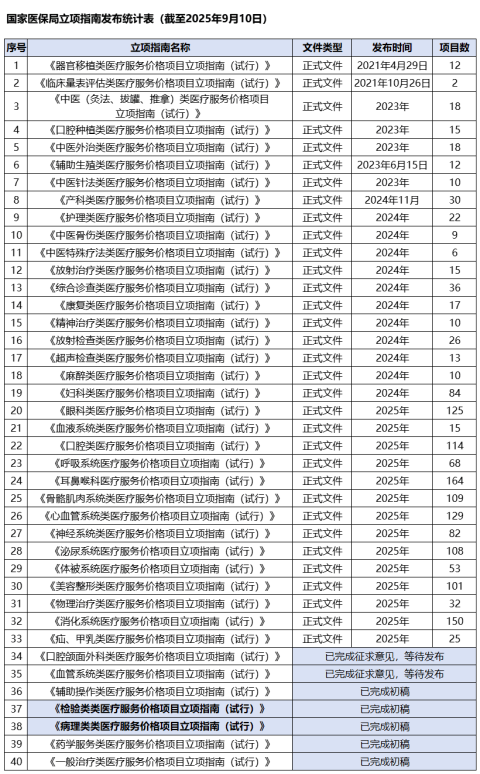
The progress of these laboratory and pathology guidelines is no accident. Since 2021, the NHSA has successively issued guidelines covering 1,640 medical service pricing items in 33 batches, spanning key areas such as organ transplantation, traditional Chinese medicine diagnosis and treatment, and dental implants. The rollout of these laboratory-testing policies is a key step in implementing the Pilot Plan for Deepening Medical Service Price Reform and the "final piece of the puzzle" in building a unified national medical service pricing system.
The Technical Specifications for National Medical Service Items (2023 Edition), issued in 2023, already makes clear that each item is defined by 17 constituent elements: item code; item name (in Chinese); item name (in English); item scope; required consumables; optional consumables; low-value consumables tier; basic labor input and time; technical difficulty; risk level; relative value of human-resource consumption; unit of measurement; notes; resource-consumption adjustment coefficient for special circumstances; billing-receipt category; accounting-subject category; and cost category on the front page of medical records.
Within these, the laboratory-testing category standardizes 1,754 laboratory examination items and 64 pathology diagnostic items according to such elements as the disposable medical consumables used, labor input and time, technical difficulty, risk level, relative value of human-resource consumption, units of measurement and financial aggregation criteria.
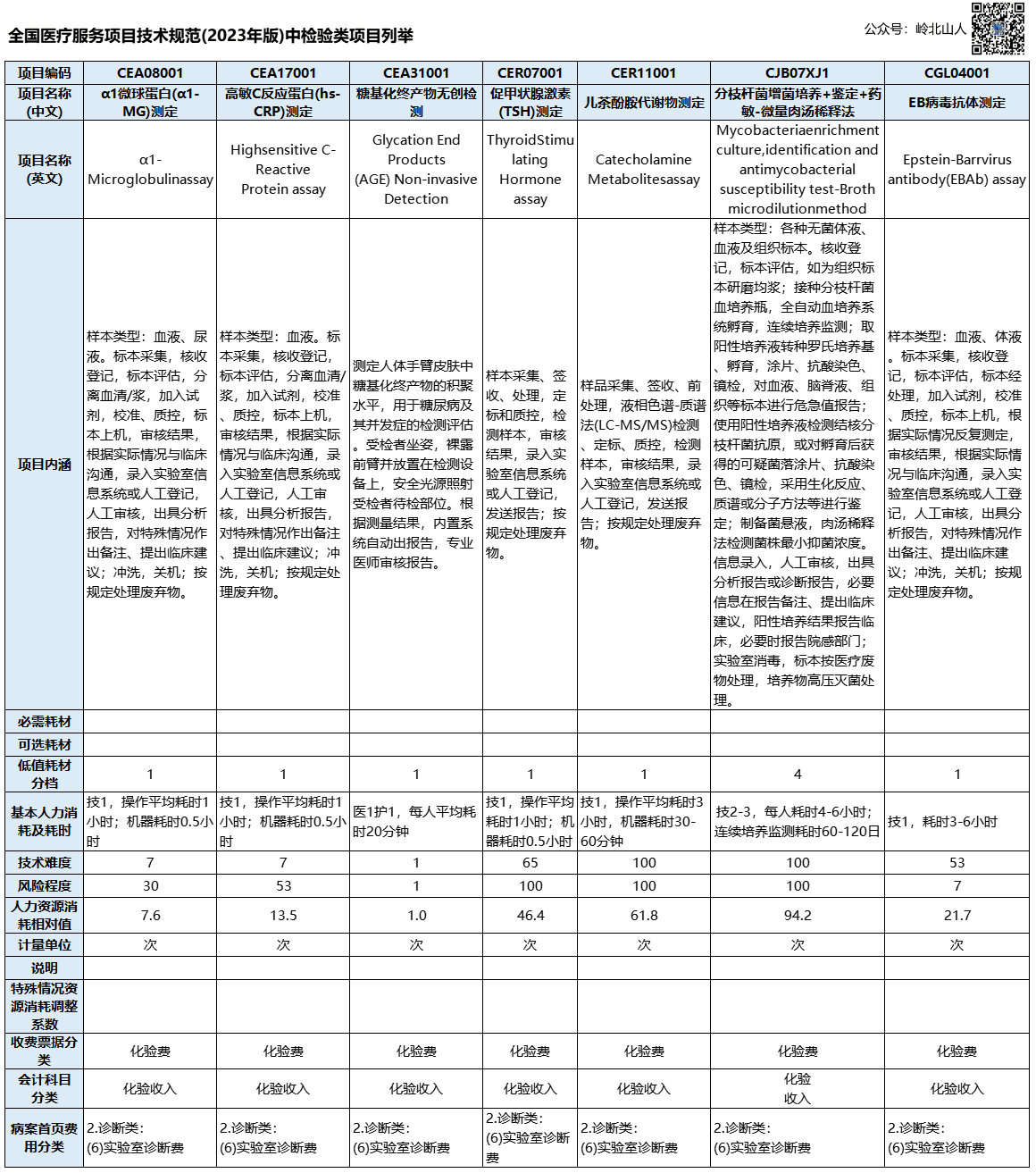
Under the technical specifications, low-value consumables are divided into tiers from 1 to 8, and basic labor input and time are classified from both the manual and the machine side. Technical difficulty ranges from 1 to 100, risk level from 1 to 100, risk difficulty from 1 to 100, and the relative value of human-resource consumption from 1 to 94.2. Every item can be classified along these dimensions, and together these dimensions form the basic structure of laboratory-testing service prices.
Integrating items is not simply a matter of "combining like with like"; it is centered on "service output", stripping away details such as operating steps and equipment models and grouping items by "specialty area + testing technology". Anhui, for instance, previously consolidated 173 radiology examination items into 26, and laboratory-testing items will most likely follow the same logic: "CBC" and "coagulation function" tests are grouped into a "clinical hematology testing group", "liver function" and "kidney function" into a "clinical chemistry testing group", and further refined by testing scenarios such as "biochemistry platform" and "immunoassay platform". This will finally put an end to the chaos of "one item, many codes, many prices". In the future, patients will be able to take a "five-parameter thyroid function" test at any hospital in the country, and both the scope of the item and the charge will be exactly the same.
"Separating technical fees from consumables" means the testing fee covers only technical labor, while consumables (such as sampling tubes and reagent cards) are billed separately. Henan, Jiangxi and other places piloted this approach, but problems soon emerged: on the one hand, a patient having a CBC might have to pay a "test fee + sampling tube fee + reagent fee", actually increasing the financial burden; on the other hand, hospitals had to manage consumable billing separately, raising administrative costs and potentially breeding "consumable markup" abuses. In 2024, Hohhot took the lead in scrapping the separation for kidney-function and cardiac-enzyme testing and restored a bundled "total item price" model. Given how tightly technology and consumables are bound together in testing services, the national policy will most likely continue along this line, folding the cost of compliant consumables directly into the total price of the testing item so that patients are not "charged piecemeal".
In the past, "different prices for different methodologies" was the norm in the industry — for example, a homocysteine assay cost RMB 50 with the enzymatic cycling method but RMB 80 with the immunoassay method, and some hospitals would bill an "enzymatic cycling test" at the immunoassay price to squeeze extra profit out of the medical insurance fund. The new policy makes clear that routine items such as clinical chemistry tests and clinical immunology tests will be priced uniformly "regardless of methodology"; only items with large differences in technical complexity, such as clinical molecular biology (for example, genetic testing) and cytogenetics, may retain methodology-based pricing. This adjustment both puts an end to the violation of "billing under a swapped methodology" and pushes hospitals to choose more efficient and economical testing methods, reducing overall medical costs.
Unified national pricing for laboratory tests will operate on a model of "provincial benchmark prices with fluctuation within the pooling region (expected ≤15%)". This adjustment delivers a three-way win for patients, hospitals and the IVD industry, and also pushes the industry more quickly into a new phase of "quality competition". For patients, transparent prices prevent overcharging when seeking care in another region, and unified item codes support mutual recognition of test results, reducing duplicate testing and truly saving both time and money. Hospitals, for their part, can use unified consumable and labor standards to force process improvements — for example, cutting costs through centralized reagent management and rational staff scheduling — while clear price benchmarks free hospitals from "pricing anxiety" so they can focus on improving testing quality. The IVD industry will finally say goodbye to the "regional price-difference dividend"; product competitiveness will instead center on "technological advantages (such as faster testing and higher accuracy)" and "cost-effectiveness (such as lower consumable waste)", and the logic of competition will shift wholesale from a "price war" to a "technology war".

Building on this three-way win, the value of unified national laboratory-test pricing will extend further toward "quality and convenience", and the supporting measures and long-term value that follow are worth looking forward to. On the one hand, the NHSA may establish a "dynamic price adjustment mechanism" that updates price benchmarks in time with consumable-cost fluctuations and advances in testing technology (such as the spread of point-of-care testing, POCT), avoiding rigid pricing; hospitals will also need to strengthen quality control — for example, through ISO 15189 laboratory accreditation — to ensure that "prices fall but quality does not". On the other hand, in the long run patients will gradually achieve "one test, valid nationwide": in the future, data from basic tests completed at home (such as blood glucose and lipid tests) could even be linked directly into hospital systems, further reducing the need to travel for care. IVD companies, meanwhile, will need to focus on core R&D — for example, developing more accurate reagents for early tumor detection and faster platforms for diagnosing infectious diseases — in order to keep thriving under a unified pricing system.
Overall, unified national pricing for laboratory tests is not merely a price adjustment; it is an important marker of the standardization of medical services in China. It will effectively end the chaos of "same item, different prices", balance medical resources and give patients peace of mind when seeking care, while also laying a healthier track for the development of the IVD industry.
Disclaimer: this article is shared for reference only and does not represent the position of this platform. If it involves copyright or other issues, please contact us as soon as possible and we will make corrections at the earliest opportunity. Thank you.