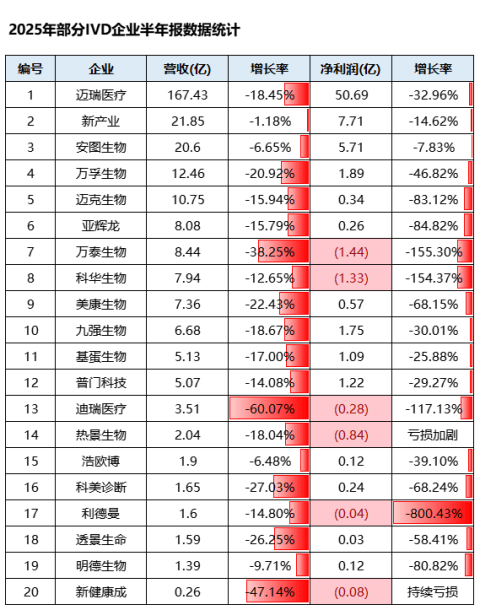
The "report cards" of the in vitro diagnostics (IVD) industry for the first half of 2025 are out. Judging from the interim reports disclosed so far, the whole industry is under unprecedented pressure, and falling revenue and profit have become the norm for most companies. Among the many factors at work, the impact of the "test-package unbundling" policy far exceeds that of centralized procurement, and it is profoundly reshaping the industry landscape.
Company-level data tell the story: Mindray Medical, the industry leader, posted first-half revenue of RMB 16.743 billion, down 18.45% year on year, and net profit of RMB 5.069 billion, down 32.96%. Mindray acknowledged that intensifying market competition and deepening medical insurance reform had pushed down both the testing volume and prices of IVD reagents, posing phased challenges for its domestic business.
The performance of other companies is no more encouraging. Wondfo Biotech's revenue fell 20.92% year on year and its net profit plunged 46.82%; Maccura Biotechnology's net profit slumped 83.12% year on year; YHLO's net profit dropped by as much as 84.82%; and Wantai BioPharm and Kehua Bio-engineering both slid into losses, with net losses of RMB 144 million and RMB 133 million respectively.
Many companies blame volume-based procurement for their declining results, but in fact the policy doing far greater damage to the industry is "test-package unbundling". Data show that volume-based procurement affects IVD companies' revenue by about 15%, while the impact of test-package unbundling exceeds 30%.
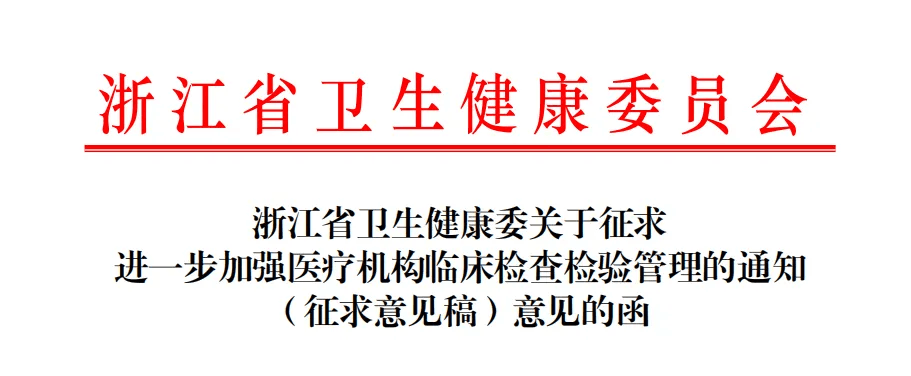
The unbundling policy was first driven by the Zhejiang Provincial Health Commission, which required that packages expressly retained in medical insurance service items may stay, while all other packages "should be dismantled wherever possible". The 2024 edition of the medical insurance catalogue currently contains 15 categories of laboratory-test packages, including routine biochemistry panels of 16 items, liver-function panels of 8 items and lipid panels of 4 items. Xuzhou and other cities have since followed suit, specifying the packages to be unbundled, such as the four-parameter coagulation panel, the five-parameter thyroid-function panel and the three-marker tumor panel.
Market responses indicate that test-package unbundling has already halved sales of the affected products. The policy's impact also varies by region and hospital tier: northern regions are more affected than southern ones, and secondary hospitals more than tertiary ones — closely related to how standardized each region's package configuration had previously been.
Beyond unbundling, policies on price governance, guidelines for establishing laboratory-testing pricing items and mutual recognition of results are also profoundly influencing the IVD industry.
On price governance, the NHSA has issued two batches of notices on standardizing and governing medical service prices, covering multiple laboratory-testing items such as thromboelastography, glycated hemoglobin (HbA1c) testing and tumor markers. Compared with volume-based procurement, directly cutting fees affects prices more immediately — at one point even sharply eroding the effect of the 28-province volume-based procurement led by Anhui's healthcare security administration.
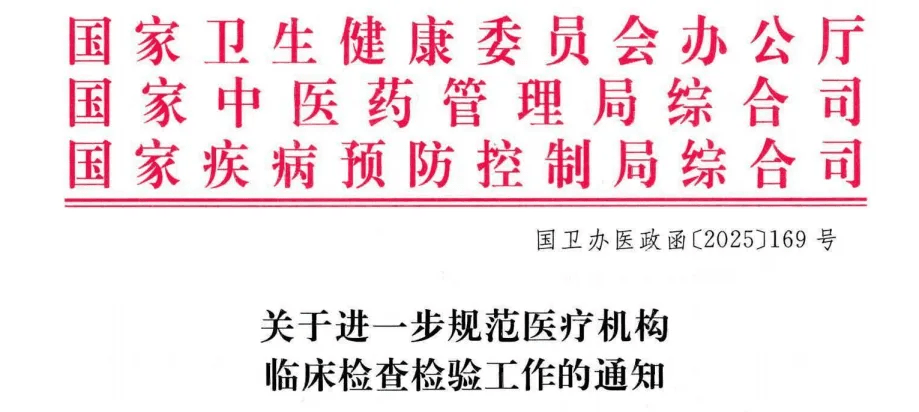
Thirty-three batches of guidelines for establishing laboratory-testing pricing items have now been released, clarifying which consumables may be billed separately. Although how laboratory-testing items will be consolidated, how they will be charged and whether the separation of technical fees from consumables will be fully implemented remain unclear, the guidelines will undoubtedly have a major impact on the content of routine IVD items and on testing technology platforms.
Mutual recognition of results, meanwhile, is advancing rapidly, whether within compact medical communities or across cross-provincial alliances such as Beijing-Tianjin-Hebei-Shandong and the Yangtze River Delta. Although this policy reduces the number of test orders, it has brought a short-term surge in demand for quality-control materials as well as growing demand for informatization software.
Despite the many challenges, the industry also holds new opportunities. Mindray Medical believes the current environment is a historic opportunity to expand its market share. At present, the average domestic share of its core IVD businesses — such as chemiluminescence, clinical chemistry and coagulation — is only about 10%; as market concentration and import substitution accelerate, leading companies enjoy ample room for growth.
On domestic substitution, Chinese brands continue to gain share in fields such as chemiluminescence, and may in the future break the dominance of foreign players in more high-end segments. For companies, the path forward lies in continuous innovation on the R&D side, launching faster, more accurate and more convenient products; in strengthening brand building; and in building stable cooperation with large channel partners to improve end-user coverage. For scenarios such as medical-community regional testing centers, offering integrated solutions of "equipment + reagents + informatization platform + technical training" will be the key to winning.
Overall, the IVD industry has entered an era of competition for existing market share. Driven by policy changes, the market structure is moving from fragmentation toward concentration. With their technological strength and brand influence, leading companies are expected to steer the direction of the industry, while the industry as a whole will upgrade through this transformation.
Source: Lingbei Shanren (an IVD-industry WeChat media account). This content is shared for reference only and does not represent the views of this platform. Copyright belongs to the original authors. If any infringement is involved, please contact us for removal.