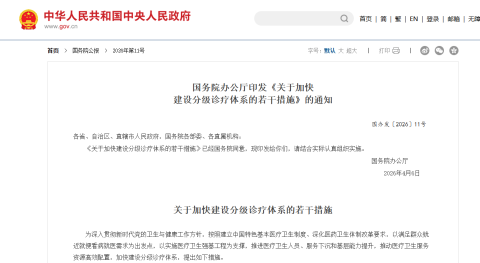
In April 2026, the General Office of the State Council issued the Several Measures on Accelerating the Construction of the Hierarchical Diagnosis and Treatment System (Guobanfa [2026] No. 11, hereinafter “the Measures”), taking compact medical consortia as the core lever to comprehensively advance the downward flow of medical resources, the upgrading of primary-care capabilities and the restructuring of the order of care-seeking. This is not only a milestone in healthcare reform, but also opens a golden window for the in vitro diagnostics (IVD) industry in county-level and primary markets, bringing structural reshaping to the industry landscape.
The Measures make clear that compact urban medical groups and compact county medical communities will serve as the main framework for driving the integration of medical care, operations and information management, with the goal of basically establishing a coordinated hierarchical diagnosis and treatment mechanism by 2030 and making the order of care-seeking more standardized and rational. The core direction points directly at first-contact care at the primary level, coordination between upper and lower levels, mutual recognition of results and intensive use of resources, upgrading county- and township-level medical institutions from “supporting extras” to “main battlefields of diagnosis and treatment”.
For the IVD industry, the policy releases three clear signals of certainty:
(1) Closing the primary-care testing gap sends equipment and reagent demand soaring
The policy calls for dynamically eliminating gaps in primary medical services, with resources from secondary and tertiary hospitals flowing downward; township health centers and community health service centers must be fully equipped with basic testing, emergency testing and chronic-disease screening equipment.
Essential categories: biochemistry analyzers, complete blood count, routine urinalysis, glycated hemoglobin, infection markers, POCT rapid diagnostics and others;
Chronic-disease dividend: primary-level institutions can issue long-term prescriptions of up to 12 weeks for chronic diseases, driving surging demand for high-frequency repeat-purchase reagents such as blood glucose, blood lipids, liver and kidney function and cardiac markers;
Market space: over the next 3–5 years, the county-level IVD market will see expansion on the scale of hundreds of billions, with primary-level equipment renewal and the expansion of test items becoming the core sources of incremental growth.
(2) Compact medical consortia reshape the procurement model, and leading companies benefit first
The Measures vigorously advance the building of compact medical consortia / medical communities, with unified planning, unified procurement, unified quality control and a unified information platform for testing resources.
Procurement authority moves upward: centralized procurement is organized by county medical communities and urban medical groups as units, delivering significant economies of scale, and IVD leaders with overall solutions, full product lines and information-integration capabilities are more likely to win bids;
Regional testing centers boom: leading hospitals of medical communities build county-level medical testing centers that take on centralized testing of township samples, driving explosive demand for automated lines, integrated biochemistry-immunoassay analyzers, cold-chain logistics and LIS systems;
Prescription-testing linkage: prescription circulation and drug coordination within medical consortia simultaneously advance the standardization of test items, the normalization of sample flows and data interconnectivity, providing stable application scenarios for IVD products.
(3) Favorable medical-insurance and pricing policies make primary-level testing more affordable
The policy uses payment levers to guide the flow of care-seeking, directly benefiting primary-level IVD business:
Wider reimbursement tiers: inpatient reimbursement rates differ by about 10 percentage points between different hospital levels, and outpatient reimbursement gradually adopts differentiated rates, steering patients toward primary-level visits and testing;
Referral deductible benefits: when patients are referred step by step from the primary level to higher-level hospitals, inpatient deductibles are calculated cumulatively; when higher-level hospitals refer patients down to the primary level, no new deductible is set within the same cycle, raising the utilization of primary-level testing;
Same disease, same payment: provinces standardize primary-level disease categories, so hospitals of different levels charge the same price and receive the same payment for the same disease, highlighting the cost-effectiveness advantage of primary-level testing.
(4) Mutual recognition of results + unified quality control: compliant IVD companies build their moats
The Measures make clear that leading hospitals assume overall responsibility for the quality of primary-level testing, making unified standards, unified quality control and unified mutual recognition of results hard requirements.
Higher industry threshold: products without traceability, without quality control or with unstable performance will be removed from medical consortium procurement lists;
Changing logic of competition: from “price war” to competition in quality, compliance and service, with companies equipped with sound external quality assessment, traceability systems and information-integration capabilities taking the advantage;
Long-term moat: participating in the building of primary-level QC systems and locking in long-term procurement by medical communities forms a closed-loop business model of equipment + reagents + services + informatization.
The unified construction and unified management model of medical communities completely breaks the traditional fragmented pattern of the IVD industry, and multiple dividends continue to be released:
The former model of scattered procurement and scattered supply is overturned: unified packaged bidding and unified distribution are organized with the medical community as the unit. A single successful bid enables an enterprise to cover the entire county market, greatly improving channel efficiency and revenue stability, and significantly expanding the procurement volume of individual projects. Chinese Government Website
The mandatory mutual recognition of test results requires high uniformity of methodology, reagents, quality control and data traceability, further clarifying quality-control standards for primary care. Brands with compliant quality, stable results and traceability gain a stronger edge, inferior products are cleared out faster, and the overall standardization of the industry is comprehensively enhanced. Chinese Government Website
The spread of chronic-disease specialty clinics at the primary level, the implementation of long-term prescriptions and the expansion of family-doctor services directly drive sustained demand growth for biochemistry, blood glucose, glycated hemoglobin and other tests; testing frequency and the served population rise steadily, and the primary testing market turns from “increment” into “constant volume”. Chinese Government Website
Regional LIS systems, full-process specimen management, cold-chain tracking, remote quality control and critical-value alerts become standard requirements; tenders for informatization continue to expand, corporate digital integration capability becomes the core threshold in procurement, and competition over single products shifts to competition over comprehensive solutions
The new policy triggers a systematic and fundamental change in the business model of the IVD industry, transforming companies from equipment and reagent suppliers into builders, operators and service providers of medical community testing systems:
On the product side: a dual boom of large equipment and digital systems
Demand for high-throughput large equipment in county-level regional testing centers is fully unleashed, underpinning centralized, large-scale testing at the county level; demand for informatization and software systems expands in parallel, with regional LIS systems, medical community data platforms, remote quality-control systems, sample logistics management systems and medical-insurance interface systems becoming essential supporting components, and the market for digital products and services keeps growing.
On the service side: full-process solutions become the core of competitiveness
Medical communities impose integrated requirements on testing quality, mutual recognition of results, data connectivity, cold-chain logistics, staff training and QC management, so companies must provide full-process services covering laboratory design, equipment configuration, reagent supply, information system construction, routine operations and maintenance, technical support and quality management, significantly raising customer stickiness and business barriers.
On the competition side: the industry concentrates faster and the head effect becomes prominent
Medical community tenders raise the bar on qualification compliance, production capacity, quality stability, service networks and informatization capabilities; small and medium enterprises lacking complete product lines, service systems and financial strength are gradually marginalized, while industry resources, project shares and policy dividends keep flowing to comprehensive, capable head enterprises, and the process of domestic substitution accelerates across the board.
For the IVD industry, the county level is the core battleground for future growth, and the medical community is the key to unlocking the county-level market. Driven by policy, industry competition is shifting from dispersed, single-point competition to holistic competition centered on county units; companies with experience in operating medical communities, integrated-solution capabilities and nationwide service networks can rapidly replicate successful models and expand across regions.
Going forward, IVD companies that can deeply adapt to medical community needs, deliver cost-effective products, provide full-process service capabilities and hold the line on quality compliance will seize the first-mover advantage in the wave of hierarchical diagnosis and treatment and share in the hundreds-of-billions market dividend brought by the upgrading of primary care.
This article is for learning and exchange purposes only. If it infringes any rights, please contact us for removal.
Previous: Advancing with Innovation, Reaching Far with Quality | Xinke Medical at CACLP 2026 in Xiamen
Next: Children’s Joy on a Happy Children’s Day | Xinke Medical Brings Childhood Playfulness into the Office!