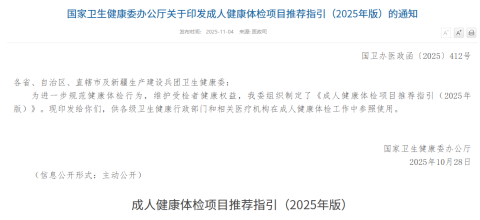
On November 4, 2025, the National Health Commission officially released the “Recommended Guidelines for Adult Health Examination Items (2025 Edition)”, which explicitly include thyroid function tests, cervical cancer screening and other items among the basic items of the health examination. This marks a further improvement of the adult health checkup system, with greater focus on early disease screening and health risk prevention.
1. Core Changes of the New Rules: Two Key Examinations Are Now Mandatory
The most closely watched adjustment in the Guidelines is that thyroid function tests and cervical cancer screening — previously “optional items” for most people — have now been formally placed in the category of basic examinations, covering all adult examinees.
Thyroid function tests: a three-item panel becomes the standard baseline
The new rules specify that thyroid function tests cover three core indicators — thyroid-stimulating hormone (TSH), free triiodothyronine (FT3) and free thyroxine (FT4) — and are the routine examinations of first choice for diagnosing hyperthyroidism and hypothyroidism.
TSH is the most sensitive indicator for assessing thyroid function and can promptly reflect abnormalities in the regulation of the thyroid gland.
As the active forms of thyroid hormones, FT3 and FT4 can directly reflect the state of thyroid function; FT3 offers higher sensitivity for the diagnosis of hyperthyroidism, while FT4 is often used in combination to confirm thyroid dysfunction.
Cervical cancer screening: combined HPV + TCT screening becomes the mainstream approach
For cervical cancer screening in women, the new rules adopt the mainstream combination of “HPV nucleic acid testing + TCT cervical cytology examination” and specify screening frequencies by age group:
Women aged 25–64: an HPV test alone or combined HPV + TCT screening every 5 years, or cytology examination every 3 years as an option.
Women over 65: routine screening may be discontinued if past screening records are adequate and all results were negative.
Persistent infection with high-risk HPV is the main cause of cervical cancer (associated with about 99% of cases), while TCT can accurately identify abnormal cervical cells; combining the two can significantly improve the early detection rate.
2. Full Checklist of Basic Health Examination Items (2025 Edition)
In addition to the newly added mandatory items, the Guidelines define a complete basic examination framework covering three major categories of core items:
General checks: height, weight, waist/hip circumference, blood pressure and pulse rate.
Multi-department physical examinations: internal medicine (lungs, heart, etc.), surgery (thyroid, breast, etc.), ophthalmology, otolaryngology and stomatology; women with a history of sexual activity need to undergo a gynecological internal examination.
Routine tests: complete blood count, urinalysis, stool routine + fecal occult blood test.
Biochemical tests: liver function, kidney function, blood lipids, fasting blood glucose, glycated hemoglobin, serum uric acid and serum homocysteine.
Molecular and cytological tests: high-risk HPV nucleic acid testing and cervical cytology examination.
Basic auxiliary items: 12-lead electrocardiogram, chest PA radiograph (or PA and lateral views) and abdominal ultrasound (liver, gallbladder, pancreas, etc.).
Targeted items: ultrasound of the uterus, adnexa and breast for women; pulmonary function tests and bone mineral density measurement for people over 40; and body composition analysis (body fat percentage, muscle distribution, etc.).
With the 2025 checkup rules now in effect, for IVD manufacturers the newly mandatory items will drive demand for the related reagents and equipment — in particular, reagents for thyroid function and cervical cancer screening. At the same time, to better meet screening needs, manufacturers need to optimize reagent stability, reduce costs, develop differentiated reagents and deploy automated laboratory lines, moving the industry from homogeneous competition toward differentiated innovation.
Previous: Nationwide Unified Lab Test Fees Are Coming! An End to “Same Test, Different Prices” — Patients, Hospitals and the IVD Industry Will All Be Affected
Next: Warm Blood Flows at Xinke Medical, Love Shines in Action!